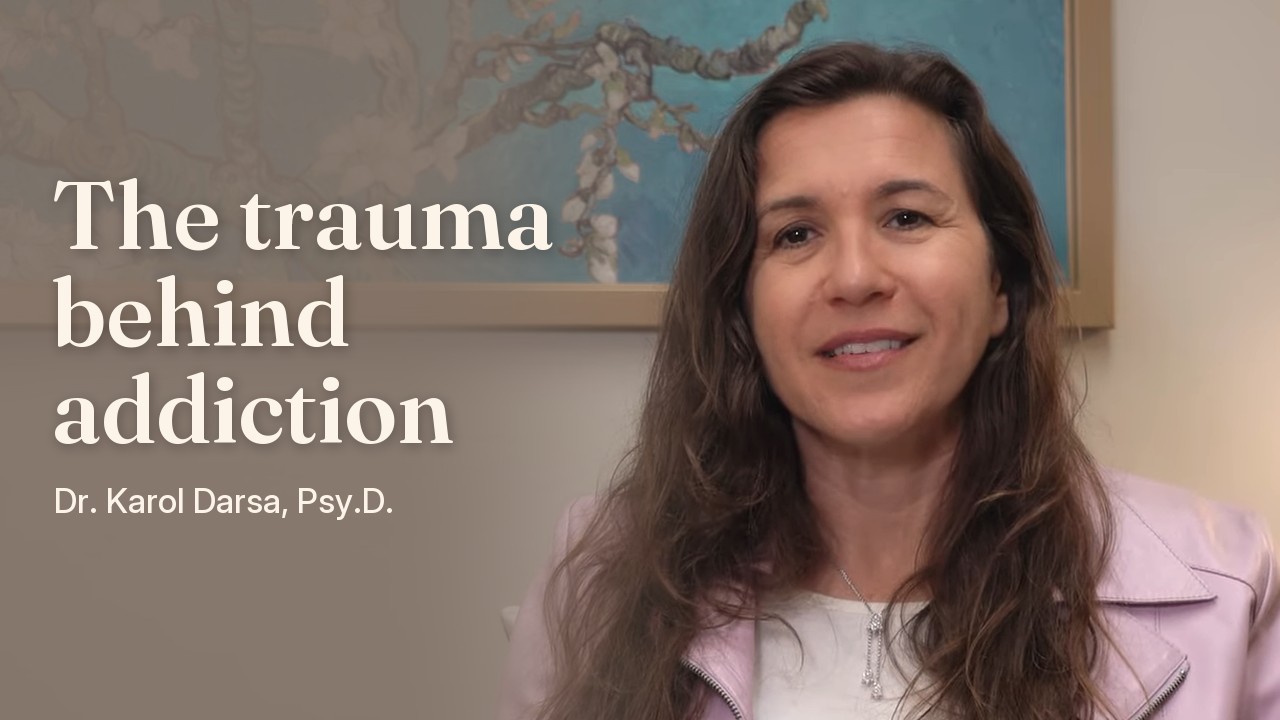
The trauma and addiction connection is something I see in my practice all the time. In my experience, an addiction very often serves a purpose: it helps a person escape feelings, body sensations or memories they don’t want to face, and those are frequently rooted in trauma. When we understand that purpose, we can stop judging the behavior and start treating what’s underneath it.
What is addiction?
An addiction is an urge to do something that’s hard to control or stop. There’s a strong sense of “I have to do it,” a feeling of relief when you do, maybe a promise that you’ll stop, and then you can’t.
Some general signs of addiction are:
- Lack of control, or being unable to stay away from a substance or a behavior
- Spending less time with other people
- Abandoning commitments or ignoring relationships
- Ignoring the risks that come with the substance or behavior
Addiction isn’t only drugs and alcohol
When I say “addiction,” most people think of drug or alcohol use. Addiction used to be thought of only as a substance, but it can also be a behavior. There’s a long list now, and some may surprise you:
- Gambling
- Sex and porn, when it becomes excessive
- Love addiction, being addicted to the feeling of being in love
- Relationship addiction, which can mean being addicted to one single person
- Technology: games, or being on social media nonstop
- Food
- Shopping
Some addictions are more harmful than others and have different consequences. But they share the same pattern: the urge, the relief, and the inability to stop. You might recognize some of this in yourself or in someone you know.
Why I look at addiction through a trauma lens
It’s very easy to judge addiction as simply a bad behavior that has to be stopped. Some people see it as a weakness, or even almost a sin: “If you were stronger, you could control yourself.” Genetics also plays a role, and I don’t want to dismiss that. Addiction has many causes.
I’m a trauma psychologist, so I tend to look at addiction from a trauma perspective. In my own practice over the years, I’ve found that half or more of the clients who come to me for trauma also have a secondary addiction. They often don’t understand why they can’t give up a substance or a behavior they know is damaging to them.
Every addiction has a function
Here’s what I explain to my clients. Every addiction, whether it’s a behavior or a substance, has a purpose underneath it.
If you’re struggling with something, ask yourself two questions. When you do it, how do you feel? Is it relief, happiness, a sense of connection? Now imagine you don’t do it. What do you feel then? It could be loneliness, sadness, anxiety, self-hatred, or simply being in your body, which you might not want to be.
That’s usually the function. The addiction masks a feeling, and sometimes a memory, that you want to escape. It’s a form of escape, a way of filling a void you haven’t found another way to fill.
When you start to understand this, I hope you stop blaming yourself. And I don’t mean you stop blaming yourself so you can keep going with the addiction. I mean it so you can treat it from the trauma side too. Take smoking. “I just have to stop smoking” is true. But if smoking gives you relief, what will you do with the feelings that come up when you stop? It’s more than the habit of the hand movement. There may be a feeling you’re trying to get rid of, and that’s where trauma comes in.
Sometimes people tell me, “I don’t know why I’m an addict.” I tell them: stop using the substance or stop the behavior, and you’ll know why. Everything you didn’t want to face will come up to the surface.
The trauma and addiction connection: attachment and the need for love
In my experience, the trauma most often connected to addiction is childhood attachment trauma. Attachment is the bond we form with a caregiver, ideally a parent. When that bond is missing, for whatever reason, a child is left without it. Maybe the parent was physically or sexually abusive. Maybe they ignored the child, and the child never really felt that connection.
We need love to survive. First we need milk, water, food and shelter. But for our emotional development, love is an absolute must. When we don’t get it, we can carry that yearning for connection for a long time.
Many people with addictions will tell you that using was the first time they felt some kind of connection. If they’re shy, lonely, or very judgmental of themselves, the substance or behavior may suddenly help them feel relaxed and connected to others. So the addiction fulfills the yearning.
In The Trauma Map, I write about how trauma causes a disconnect from yourself: from your body, your feelings, and other people. Addiction fits the same picture. You’re trying to connect to something, and you use a substance or another person to do it.
By the way, people with addictions can be highly functioning. Don’t think that an alcohol problem means you have to be homeless and drinking on the street all day. You can have an addiction and be very successful in life, and still never get out of that sense of disconnection.
Addiction and the flight response
You may have heard of the fight, flight or freeze response. When something traumatic happens, an older, survival part of the brain takes over and our rational thinking goes offline. We fight back, we run away to protect ourselves, or we freeze and go into a kind of shock.
The way I understand addiction, and explain it to my clients, is that it grows out of the flight part. Flight wants to run away. When something painful or stressful happens, we don’t want to feel the pain, so we try to escape. An addiction can become one way of running.
Try watching yourself during the day. In a stressful situation, or even a boring class, does your mind keep wanting to go somewhere else? Are you trying to run away from your past, from a relationship that isn’t satisfying, from your career, or from a boss who treats you badly? If you find yourself daydreaming about getting away a lot, that urge to escape is worth paying attention to.
How to treat trauma and addiction together
Not every addiction comes from trauma. But very often, in my experience, it’s rooted in it. That’s why I suggest treating both together. If you or someone you love has an addiction, look for a trauma professional as well, or start by educating yourself about trauma. Yes, treating the addiction means stopping the behavior. Alongside that, look at the trauma that may be driving it, so it doesn’t get forgotten.
One important safety note: stopping some substances suddenly, such as alcohol, benzodiazepines or opioids, can be medically risky. If you’re physically dependent, talk to a doctor about medically supervised detox or treatment before you stop.
Healing also means reconnecting. That includes your emotions, which means accepting them and making peace with them, and your body, which is absolutely crucial. (If being in your body feels hard, a simple grounding exercise can be one place to start.)
Please don’t judge people with addictions, and don’t judge yourself. There’s still a lot of stigma, as if it were a matter of strength or weakness. Judging doesn’t help anyone. What helps is compassion and understanding.
Watch the video
I talk about addiction and its connection to trauma in this video from my YouTube channel.
Frequently asked questions
Is all addiction caused by trauma?
No. Addiction has many causes, and genetics plays a role. But in my work, addiction is very often rooted in trauma, especially childhood attachment trauma, so I always look for it.
Can you have an addiction and still function well?
Yes. Many people with addictions are highly functioning and successful. Being able to hold a job or keep up appearances doesn’t mean there’s no addiction, and it doesn’t mean there’s no pain underneath.
Why do feelings get worse when I stop?
Because the addiction was covering them. When you stop, the loneliness, sadness, anxiety or memories it was masking come to the surface. That’s why it helps to have support for those feelings, not only a plan to stop.
When to reach out for support
If you see yourself or someone you love in this article, you don’t have to handle it alone. Trauma-informed support can help you understand what the addiction is doing for you and find other ways to meet that need.
For help finding addiction treatment, you can call the SAMHSA National Helpline at 1-800-662-4357. It’s free, confidential and available 24/7 for treatment referrals and information. If you are in crisis, call or text 988 (Suicide & Crisis Lifeline) or call 911.
This article is for education and isn’t a substitute for professional care. Dr. Karol Darsa, Psy.D., is a licensed psychologist in California (PSY 19847) with 28 years of experience, author of The Trauma Map: Five Steps to Reconnect With Yourself, and founder of Reconnect Integrative Trauma Treatment Center.