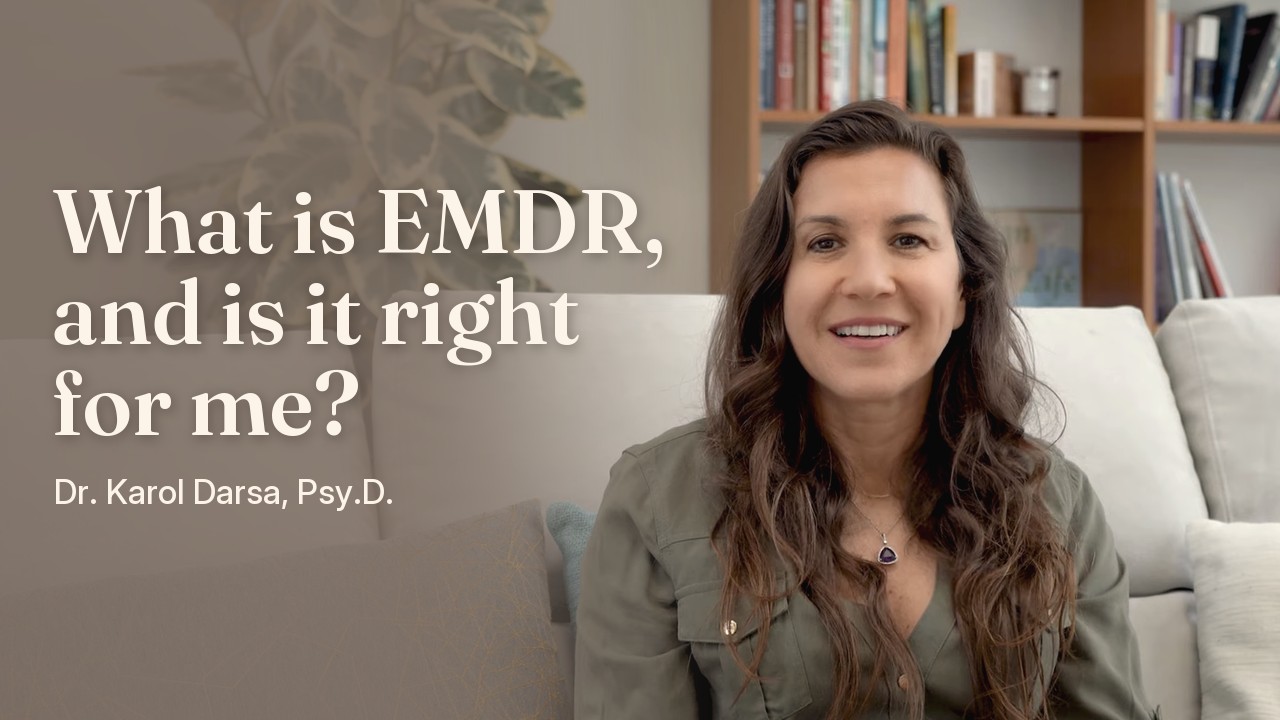
EMDR (Eye Movement Desensitization and Reprocessing) is an evidence-based trauma therapy. While you hold a painful memory in mind, your therapist guides you through bilateral stimulation, like side-to-side eye movements, tapping or tones, and over time the memory loses much of its emotional charge. If you’re asking “what is EMDR therapy, and is it right for me?”, the answer also has to include how to do it safely, because EMDR done too fast can make you feel worse.
I’ve been trained in EMDR for about 20 years, and I use it with my clients. I like it very much. I’ve also seen people feel worse after EMDR that went too fast, so in this article I want to explain the basics and then the cautions I give everyone.
What is EMDR therapy, and where did it come from?
EMDR was developed by the psychologist Francine Shapiro in the late 1980s. It started in an unusual way. She was out on a walk, feeling upset and thinking about a distressing memory, and she noticed her eyes moving quickly from side to side. Then she realized the upset had gone down. She began testing this with other people and first published her results in 1989.
Later, therapists found that other kinds of bilateral stimulation (stimulation that alternates left and right) can work too. Today that can mean eye movements, tapping on the hands or knees, or tones played in one ear and then the other.
EMDR is now practiced all over the world. The American Psychological Association’s clinical practice guideline for PTSD includes it as a recommended treatment option. There’s a full eight-phase protocol behind it. I won’t go through all of it here, because a well-trained therapist will guide you through it.
What EMDR can help with
In my practice, I use EMDR for trauma and painful memories, for anxiety, and for negative beliefs about yourself that get stuck, like “I’m not good enough” or “It was my fault.” Some clinicians also use it for depression and chronic pain. The research is strongest for PTSD, and the evidence for other uses is still growing, so talk with your therapist about what fits your situation.
Why not just talk about it? When we talk about trauma or a very stressful situation, we might feel a little relief. But talking alone doesn’t always resolve it. Sometimes you can access the memory but you can’t really process it. And depending on how severe the trauma was, talking about it again and again can even make you feel worse.
Shapiro explained EMDR with what she called the Adaptive Information Processing model. The idea is that a traumatic memory gets stored without being fully processed, so the original emotions, beliefs and body sensations stay attached to it. The way I explain it to my clients is this: while you stay with the memory and the bilateral stimulation is happening, the feelings come up to the surface, and then their intensity starts to decrease.
Caution 1: Don’t do EMDR on yourself from YouTube
We live in a time when you can google anything, and you’ll find videos that show you “how to do EMDR.” I don’t recommend doing EMDR on your own. Even if you’ve received EMDR before and you think you know how it goes, it’s still not my recommendation.
A trauma memory can open up quickly, and when you’re alone, there’s no one to notice that you’re getting overwhelmed or starting to leave your body. That’s the job of a trained therapist. Training in the EMDR technique is a start, but you want a therapist who really understands trauma overall.
Caution 2: Don’t skip stabilization
Before you go anywhere near a traumatic memory, you need a phase of stabilization. This means learning ways to calm your nervous system down first. Your therapist should teach you some of these tools. Breathing, grounding, EFT tapping and the butterfly hug (crossing your arms and tapping your shoulders, left and right) are a few of them. We also call this phase resourcing, because you’re finding resources inside yourself and in your life outside. As these grow, your mood gets a little better and your capacity to tolerate feelings gets better too.
There’s a common belief that we heal only if we say exactly what happened, in detail, maybe over and over again, to “release” it. That isn’t accurate. In my experience, smaller steps work better, and so does bringing the body into the healing. I write more about this, and about what each phase of recovery looks like, in Signs You’re Healing From Trauma.
People often ask me, “Can I work on something I don’t fully remember?” Maybe you have a sense that something happened, or you have nightmares or physical sensations, but you don’t know who or when. Yes, you can. What we want is for you to move through some of the memory and the feelings without breaking apart and without dissociating.
Part of that is staying present. If you’re working on something that happened when you were five, you aren’t trying to relive it as a five-year-old. You never forget that you are an adult right now, sitting in this room. You feel your body and you know where you are. From there, your therapist can use bilateral stimulation to bring up the painful feelings from the past.
Caution 3: Stay inside your window of tolerance
The window of tolerance is the range of emotion you can handle while still functioning. During a normal day my feelings go up and down. I might get upset or a little sad, but I can still work, take care of my kids, understand what people say to me and think clearly. That’s being inside the window.
During EMDR processing you can go out of that window in two directions. You can go too high: you start hyperventilating, or crying so hard you don’t know where you are anymore, or you can’t hear what your therapist is saying. Or you can go too low, where you become very flat and checked out, almost frozen.
Both are signs that it was too much. If that happens, don’t hesitate to stop. Tell your therapist, “That was too much for me.” Then go back to your grounding and resourcing tools. Tap, breathe, or get up and move. When you feel calmer, check in with yourself: am I ready to continue today? If you’re not, please don’t push.
Unfortunately, even some well-meaning therapists were taught that catharsis is necessary, and that the more you cry, the more you release and the more you heal. I don’t agree with that. Pushing yourself to “just get it done” isn’t helpful, and it can even be retraumatizing. You want to leave a session feeling that you accomplished something and that you could tolerate the feelings. Then next time you work on the next part of the memory. You don’t want to feel so overwhelmed that you’re in bed for days afterward.
How to find the right EMDR therapist
The good news is that many therapists are trained in EMDR, in the United States and internationally. The EMDR International Association (EMDRIA) sets training standards and has a “Find an EMDR Therapist” directory on its website. When you talk with a possible therapist, ask about their EMDR training, how much trauma work they do, how they handle the stabilization phase, and what they’ll do if you get overwhelmed in a session. Their answers will tell you a lot.
Watch the video
I talk through EMDR and these cautions in this video from my YouTube channel:
Frequently asked questions
Can I do EMDR on myself?
I don’t recommend it, even if you’ve had EMDR before. Painful memories can come up fast, and you need someone trained in trauma who can notice when you’re leaving your window of tolerance and help you come back.
Do I have to remember everything that happened?
No. You can work with a vague sense of what happened, with nightmares, or with body sensations. What matters is moving through the feelings while you stay present.
Is it normal to feel overwhelmed during EMDR?
Some emotion is expected. But if you’re flooded, can’t hear your therapist, or go numb and frozen, that was too much. Stop, ground yourself, and slow the pace. Healing should happen in a gentle, slow and compassionate way.
When to reach out for support
If memories, anxiety or old beliefs keep pulling you out of your life, and talking about them hasn’t been enough, EMDR with a trauma-trained therapist may help. Start with someone who will build stability with you first.
- Learn about psychotherapy with Dr. Darsa
- Explore trauma coaching
- Read The Trauma Map: Five Steps to Reconnect With Yourself
If you are in crisis, call or text 988 (Suicide & Crisis Lifeline) or call 911.
This article is for education and isn’t a substitute for professional care. Dr. Karol Darsa, Psy.D., is a licensed psychologist in California (PSY 19847) with 28 years of experience, advanced training in EMDR, the author of The Trauma Map, and the founder of Reconnect Integrative Trauma Treatment Center.