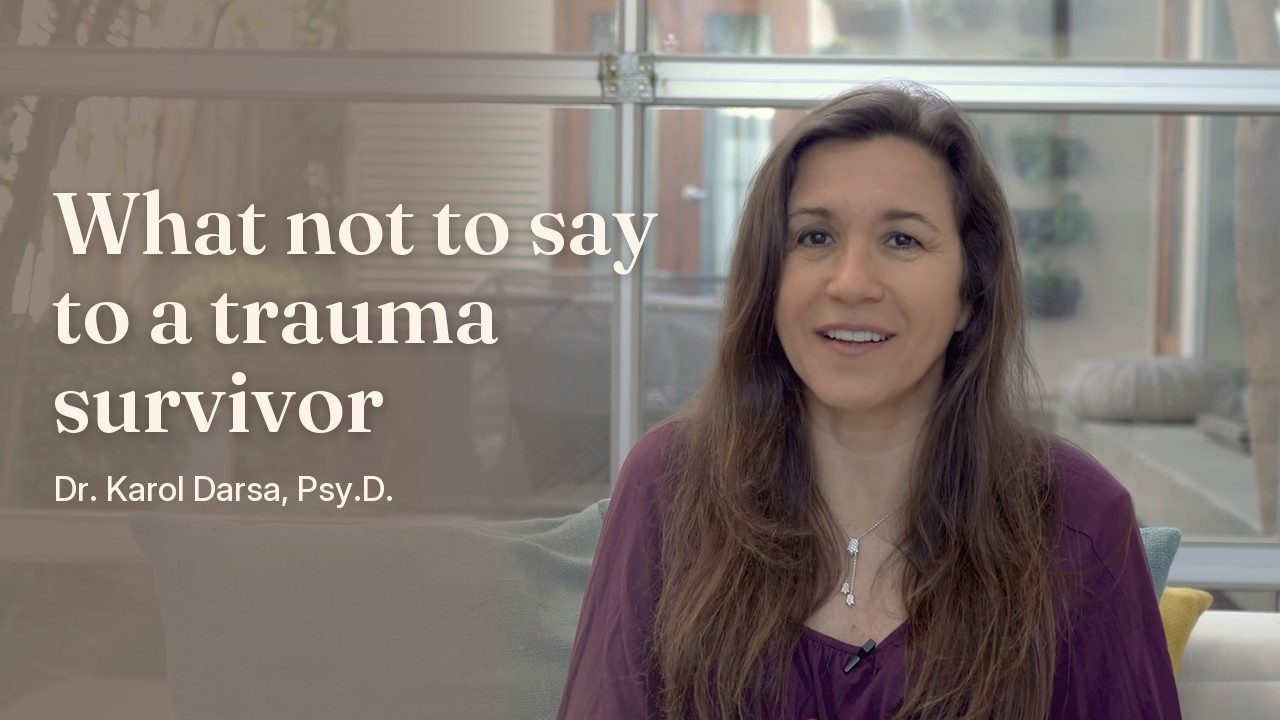
If someone you love has been through trauma, the words you choose can help them feel less alone, or they can make them feel judged and shut down. In this article I go through what not to say to a trauma survivor, ten common phrases I hear about from clients, and what you can say instead. Almost all of these come from good intentions. That’s why they’re easy to miss.
The trauma may be recent, or it may be years old and your loved one is only now starting to work on it. Of course you want to help. But even with the best intentions, you can say the wrong thing and hurt the person, and hurt your relationship with them too.
What not to say to a trauma survivor: 10 phrases to avoid
1. “I know what you’re going through.”
You usually say this because you want the person to feel understood. Often, though, it lands as minimizing, especially when it’s followed by “because so-and-so had the same thing.” Even if you’ve been through something similar yourself, you may not know exactly what this person is going through. Every experience is different. Two soldiers can be in the same war and have very different reactions to it.
2. “It was so long ago. You should move on already.”
This one often creates a lot of anger. It can also leave the person feeling guilty and weak: “Why can’t I just move on?” The idea that time heals everything is a myth. Unfortunately, some traumas don’t heal with time. Just because something happened long ago doesn’t mean the person is ready to let it go.
3. “It’s not so bad. Other people have it worse.”
This is minimizing too. Now the person may feel selfish, as if they’re making themselves a victim. When someone is being hurt, abused or attacked, they don’t think, “Well, other people have it worse, so I should be okay.” There’s no such thing.
4. “It’s going to be okay.”
This might be the most well-meaning statement on the list. You’re trying to soothe the person. But none of us knows the future, so you can’t really know it will be okay. And the person is in fear right now. They may think, “How do you know?” and feel even more alone with it.
5. “You need to be stronger than the trauma.”
Here’s the judgment again: that you aren’t strong enough, or that you could beat this with your mind if you just tried harder. We’re talking about trauma here, something that impacts the whole person, and you can’t just talk yourself out of it. If someone breaks their arm, would you tell them to be stronger than their broken arm? Their arm is injured. An emotional injury deserves the same understanding. Be careful with words about strength and weakness so you don’t come across as judgmental.
6. “You’re being a drama queen. You’re too sensitive.”
The words “drama queen” are so triggering for many people, especially if they grew up in a family where they weren’t allowed to feel anything. When they cried they heard “you’re too sensitive,” “look at your brother, he doesn’t cry,” or “I’ll give you something to cry about.” If you’re a parent or you have siblings, you know no two children are alike. Being sensitive isn’t a bad thing. When someone is crying or feeling a lot of emotion, they’re feeling the intensity of it. It doesn’t mean they’re doing it for attention.
7. “They didn’t mean to hurt you.”
This one is in the same family as “they did their best, they didn’t know any better.” There might be some truth to that. But imagine you’re walking past a construction site and something falls on your head and gives you a concussion. Does it matter whether it was intentional? You’re still injured. Trauma works the same way. What matters is the impact on you, the emotional injury and sometimes the physical one too.
Survivors say this to themselves as well: “My parents didn’t really mean it,” or “My uncle didn’t say it in a bad way.” Your feelings can still be hurt, and you can still be traumatized by what happened. The intention doesn’t change that.
8. “You must forgive the people who hurt you.”
This pressure often comes from a spiritual or religious place, and people will tell you forgiveness is good for you. That’s true, it can be. But it shouldn’t be the ultimate goal. Some people may never be able to forgive the person who hurt them, and if they feel they have to, they can end up feeling inadequate about themselves. Forgiveness is a very personal decision. When we’re talking about severe sexual or physical abuse, it isn’t easy for a survivor to forgive the perpetrator. Please stay out of that decision.
9. “Tell me every detail. You’ll feel better.”
I have to say, this is one of my favorites. You don’t have to talk about what happened in order to feel better, and you especially don’t need to tell it over and over again. Traumatic memories can heal without the person ever disclosing what happened, if that’s too painful. Telling the story isn’t a requirement. (I explain more about this in how healing from trauma actually unfolds.)
10. “You should try this.”
Unsolicited advice about how to get over it often sounds like “you’re not doing enough” or “you haven’t tried hard enough.” I understand the intention behind it. For the survivor, it may not be welcome.
Do you say these things to yourself?
Go back through the list and ask yourself one honest question. Do you say any of these things to yourself? “It was so long ago.” “Others have it worse.” “They didn’t mean it.” This is a place where you can start changing your own language.
What to say instead
“I’m sorry you’re hurting.” Or “I’m sorry you’re scared,” “I’m sorry you’re in pain.” That’s it. No “but,” no “however.” Hearing this alone can be so healing. Try saying it to yourself, too, instead of the usual list of “buts.”
“Is there anything I can do for you?” Instead of doing what you think they need, ask. If there’s nothing, that’s okay too, so they don’t feel they have to come up with something.
“I’m here for you if you want to share. Or if you just want to sit with me.” The key is that sharing is their choice. What you’re offering is company, so they don’t feel alone in the pain. What happened is traumatic, but feeling alone with it can be even more painful.
“I can’t even imagine how this must feel.” See the difference from “I know what you’re going through”? The person might answer, “You’re right, you can’t.” Even so, it acknowledges them.
“All your feelings are normal, and they’re all welcome.” There’s no right or wrong way to feel. If you’re angry, that’s okay. If you’re sad, that’s okay. If you don’t feel anything, that’s okay too. No judgment about how they feel or about what happened.
“It’s okay to talk to a professional.” Give the person permission, so they don’t think, “Now I have to go to therapy, so I must be weak.” Where I live, in California, going to therapy is fairly normal. In many cultures there’s still a lot of judgment about it. When I was growing up, the belief was that unless you were crazy, you didn’t go for professional help. People are becoming more open-minded, and a simple “it’s okay” can help.
“My prayers are with you.” If you share a religious or spiritual belief with the person, praying together or doing a ritual that comforts them can be a real support.
Watch the video
I talk through all ten of these, and what to say instead, in this video from my YouTube channel.
Frequently asked questions
What is the best thing to say to a trauma survivor?
Keep it simple: “I’m sorry you’re hurting,” with nothing added after it. Then ask, “Is there anything I can do?” and let them know you’re there if they want to talk, or if they just want company.
Should I encourage someone to talk about their trauma?
Let them know you’re available, but don’t push for details. Healing doesn’t require telling the story, and retelling it again and again can be painful. Let the person decide what, and how much, to share.
Is it wrong to tell a survivor they should forgive?
Forgiveness can be good for people, but it’s a personal choice and it doesn’t have to be the goal. Pressure to forgive, especially after severe abuse, can leave a survivor feeling inadequate. It’s their decision, not yours.
When to reach out for support
If you’re a survivor and these words sound like the voice in your own head, or you’re a loved one who wants to support someone better, you don’t have to figure it out alone. Working with a trauma-informed professional can help.
- Learn about psychotherapy with me
- Explore trauma coaching
- Read my book, The Trauma Map, which has tools you can share with someone you love
If you are in crisis, call or text 988 (Suicide & Crisis Lifeline) or call 911.
This article is for education and isn’t a substitute for professional care. Dr. Karol Darsa, Psy.D., is a licensed psychologist in California (PSY 19847) with 28 years of experience, author of The Trauma Map: Five Steps to Reconnect With Yourself, and founder of Reconnect Integrative Trauma Treatment Center.